
- today
- label News
- favorite 0 likes
- remove_red_eye 85 views
- comment 0 comments
TL;DR
Autumn means less daylight, damp weather and more time indoors, all of which favour respiratory infections, including CIRDC.
Diet is the foundation of immunity: animal protein, omega-3 EPA/DHA, zinc, selenium, vitamins E and D, pre- and probiotics, and beta-glucans 1,3/1,6.
The gut microbiome steers immunity via SCFAs (acetate, butyrate, propionate) and regulatory T cells; dysbiosis means inflammation and weaker defences.
A cat is not a small dog: it needs preformed taurine, arginine and vitamin A as retinol, which it cannot synthesise in sufficient amounts.
An effective plan combines targeted, correctly dosed supplementation, hydration, exercise and grooming.
Always discuss any change in diet or supplements with your vet.
Autumn puts real strain on a dog's and cat's body. Shorter days, less exposure to light, damp and draughts, and more hours spent indoors all increase the risk of respiratory infections, including canine infectious respiratory disease complex (CIRDC, better known as kennel cough), a major cause of which in Europe is Bordetella bronchiseptica (Day et al., 2020). Yet no single supplement will build immunity on its own. Immunity is the result of a system: diet, targeted supplementation and care. This homeostatic approach, which treats the body as a whole, lies at the heart of the Bemo philosophy.
Dog and cat immunity in autumn – what happens in the body
Seasonal changes in immunity have a physiological basis. In dogs, fluctuations in cell-mediated immunity over the year and seasonal changes in the serum metabolite profile have been described (Shifrine et al.; Walker et al., 2022). Some of the data on the effect of day length come from rodent models, so we treat them as an approximation. The key mechanism, however, is well documented:
- The gut microbiome regulates immunity via short-chain fatty acids (SCFAs: acetate, butyrate, propionate) and regulatory T cells; dysbiosis leads to inflammation and weaker immunity (Yang et al., 2025).
- A high-protein diet based on animal protein supports Lactobacillus bacteria and a tight gut barrier, whereas excess fat and refined carbohydrates promote dysbiosis (Yang et al., 2025).
- In older animals, immunosenescence and "inflammaging" increase: T and B lymphocyte counts fall, while levels of pro-inflammatory cytokines such as IL-6 and TNF-α rise (McKenzie, 2025).
Watch out: don't diagnose based on symptoms. A dull coat or low energy can have many causes, and identifying them is a job for your vet.
Diet as the foundation – what genuinely strengthens immunity
Before you reach for a supplement, check the composition of the food. It supplies most of the nutrients that build immunity. The table below shows what to look for.
| Nutrient | Role | Where to find it in the composition |
|---|---|---|
| Animal protein | Supports Lactobacillus and the gut barrier | Meat listed first |
| Omega-3 (EPA/DHA) | Calms inflammation, supports skin and coat | Fish oils, oily fish |
| Zinc | Supports the skin barrier and cell-mediated immunity | Mineral additives |
| Selenium | Acts as an antioxidant | Natural sources, e.g. rabbit meat |
| Vitamin E | Protects cells against oxidative stress | Vitamin additives |
| Vitamin D | Supports innate immunity | Vitamin additives |
| Pre-/probiotics | Feed and replenish the microbiome | MOS, FOS, bacterial cultures |
| Beta-glucans 1,3/1,6 | Activate immune cells | Yeast, extracts |
A good point of reference is Bemo Vital food: it contains beta-glucans 1,3/1,6, the prebiotics MOS and FOS, and selenium from rabbit meat, as well as vitamin A 8,000 IU/kg, vitamin D3 800 IU/kg, vitamin E 65 mg/kg and zinc 180 mg/kg, with digestibility of around 94%. High digestibility means less strain on the digestive tract, which matters in practice during autumn. Grains are not harmful in themselves, but for animals with a sensitive digestive system or allergies, recipes based on animal meat work better.
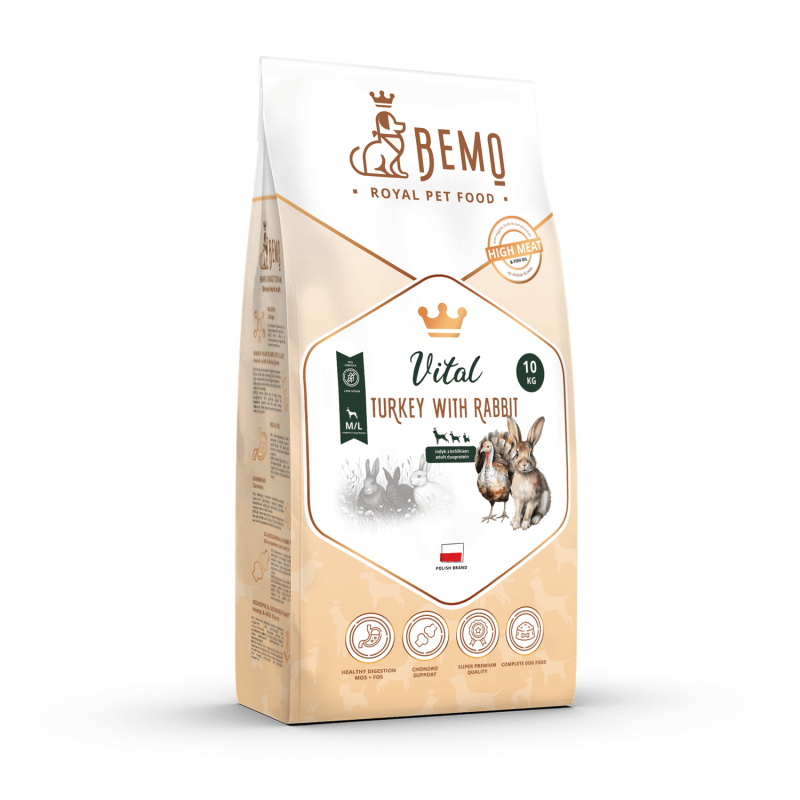
Bemo Vital – immunity-boosting dry dog food with turkey and rabbit
Complete super-premium food with beta-glucans 1,3/1,6, MOS/FOS and selenium from rabbit meat, supporting the immune system and gut function.
How much to give? Practical doses of omega-3, beta-glucans and probiotics
This is the question that most often goes unanswered. The values below are indicative and should be discussed with your vet.
| Nutrient | Goal | Daily dose | Bemo product |
|---|---|---|---|
| Omega-3 | Metabolic functions | min. approx. 30 mg/kg BW | Salmon oil: 1 pump (≈2 g)/5 kg |
| Omega-3 | Health goals | up to approx. 370 mg/kg BW | Cod liver oil: 1 g/10 kg |
| Beta-glucans | Immune modulation | 0.07–0.28% of the food | Immune Extra: 1 capsule/20 kg |
| Probiotics | Gut microbiota | as per product | Diar Stop: 5 ml/10 kg |
A study by Carlisle et al. (2024) showed that giving 68 mg of omega-3 per kg of body weight daily for 16 weeks raised the Omega-3 Index in dogs from 1.4% to 3.3% and was associated with reduced pain perception. Marchi et al. (2024), in turn, showed that beta-glucans in food at 0.07–0.28% over 140 days modulated dogs' immunity and microbiome. A Bemo Immune Extra capsule provides 130 mg of beta-glucan, 20 mg of vitamin C, 5 mg of vitamin E, 25 µg of selenium, 200 mg of rosehip and 150 mg of echinacea. Cod liver oil and capsules can be combined, as long as the sources of vitamins A and D don't overlap. Supplementation usually lasts a few weeks, and the decision to extend it rests with your vet.

Bemo VetLine Immune Extra – immune support for dogs and cats
Capsules with beta-glucan 1,3/1,6, vitamin C, rosehip and echinacea, supporting natural immunity when the body is run down.
Dog vs cat – what you must not mix up
The cat is an obligate carnivore and must not be fed like a dog. It needs preformed taurine, arginine, vitamin A as retinol and arachidonic acid, which it cannot synthesise in sufficient amounts (Tufts, 2018). Taurine deficiency leads to retinal degeneration and dilated cardiomyopathy (Knopf et al., 1978). Dogs synthesise taurine and vitamin A from precursors and have a lower protein requirement.
| Nutrient | Dog | Cat | Consequence of deficiency in cats |
|---|---|---|---|
| Taurine | Synthesises it | Needs it from the diet | Retinal degeneration, cardiomyopathy |
| Arginine | Synthesises it | Needs it from the diet | Hyperammonaemia |
| Vitamin A | From precursors | Retinol only | Vision and skin problems |
| Arachidonic acid | Synthesises it | Needs it from the diet | Skin and reproductive disorders |
That's why a dog supplement can't replace a cat one, and a cat shouldn't be fed dog food. Bemo Cat Trout contains 99% trout, 2,500 mg/kg of taurine and vitamin A at 2,670 IU/kg, covering a cat's specific needs. The Bemo Cat Marines Salmon & Calamari variant combines salmon and squid with beta-glucans and the prebiotics MOS and FOS.
Natural support – what has evidence and what is a hypothesis
Not all "natural" ingredients have equally strong scientific backing. Separating facts from hypotheses honestly is crucial.
| Ingredient | Level of evidence | Practical takeaway |
|---|---|---|
| Fish oils (EPA/DHA) | High | The best-documented support |
| Colostrum | Moderate | Evidence mainly for young animals |
| Echinacea | Low | Individual studies, no standardised doses |
| Black elder | Very low | Raw material can be toxic |
| Adaptogens | None | Treat as a hypothesis |
It's worth basing your choice of omega-3 source on data.
| Bemo source | EPA | DHA | Also |
|---|---|---|---|
| Cod liver oil | 11.6% | 9.3% | Vit. D3, MSC-C-58547 certificate |
| Salmon oil | 10.5 g/100 g | 8.5 g/100 g | FSSC 22000 |
| Krill oil | 4.4 g/100 g | 1.2 g/100 g | Astaxanthin 1,670 mg/kg |
Cod liver oil has the highest concentration of EPA and DHA, salmon oil has a mild taste, and krill provides astaxanthin, an antioxidant. Krill is not automatically "better" than cod liver oil; the choice depends on the goal and on how well the animal tolerates it. It's also worth remembering that Bemo natural supplements include both oils and vitamin and mineral preparations.

Bemo Gummies MultiVit – multivitamin gummies for dogs and cats
Tasty gummies with spirulina and rosehip, supporting your pet's everyday immunity, vitality and overall condition.
Hydration, exercise and grooming – immunity beyond the bowl
Diet isn't everything. Cats drink little, and their approximate water requirement is around 50 ml/kg of body weight per day (a value to be verified). Support their intake with wet food and a water fountain. Bemo Cat Trout, at 101 kcal/100 g, combines hydration with complete protein. Dogs shouldn't skip walks in autumn; regular, moderate exercise supports circulation and the immune system.
An autumn routine for owners:
- Dry the coat after a walk in the rain.
- Rinse and protect paws after contact with mud and road salt.
- Watch for stiff joints, especially in seniors.
- Provide constant access to fresh water.
- Keep a regular walking schedule.
- Limit the stress of changes to routine.
- Check the temperature of the resting place.
- Remember parasite prevention.
- Introduce diet changes gradually.
- Note down any symptoms that don't go away.
Safety – when to be careful
Supplementation has its limits. Don't combine several sources of vitamins A and D without advice, as an excess can be toxic. Selenium is subject to legal limits in the European Union, and the FEDIAF guidelines (2025) set permitted levels in pet food. Discuss supplementation with your vet, especially for chronically ill, pregnant and lactating animals.
When to see the vet:
- Loss of appetite lasting more than a day.
- Lethargy and a clear drop in activity.
- Recurring diarrhoea or vomiting.
- Coughing, sneezing, nasal discharge.
- Difficulty breathing.
- Sudden stiffness or lameness.
Don't use a supplement as a substitute for getting symptoms checked. A supplement supports the body, but it doesn't cure.
Summary and next steps
Supporting immunity in autumn rests on four pillars: a well-balanced diet with animal protein and omega-3, targeted supplementation at the right doses, grooming and care, and advice from your vet. Start by checking the composition of the food, then choose an oil and an immune supplement to match body weight, and finally take care of hydration and a walking routine. Explore Bemo's food and supplements that support immunity and talk to a Bemo nutrition adviser to tailor the plan to your animal.
FAQ
Does autumn really weaken a dog's and cat's immunity?
Yes. Shorter days, damp and more time indoors increase the risk of respiratory infections, including CIRDC. Seasonal fluctuations in cell-mediated immunity have also been described in dogs.
How much omega-3 should a dog get?
A minimum of around 30 mg/kg of body weight per day for metabolic functions, up to around 370 mg/kg for health goals. These values are indicative and should be discussed with your vet.
Will a dog supplement work for a cat?
No. Cats need preformed taurine, arginine and vitamin A as retinol, which dogs don't need to the same extent. Use products designed for cats.
Can a cat eat dog food?
It shouldn't. Dog food doesn't cover a cat's specific needs, which risks deficiencies if fed for a long time.
How long should immune support be given?
Usually a few weeks, depending on the product and the goal. The decision to extend supplementation rests with your vet.
Can cod liver oil and immune capsules be combined?
Yes, as long as the sources of vitamins A and D don't overlap. An excess of these vitamins can be toxic, so check the combination with your vet.
Is krill better than cod liver oil?
There is no clear-cut answer. Cod liver oil has a higher concentration of EPA and DHA, while krill provides astaxanthin. The choice depends on the goal and on how well the animal tolerates it.
Comments (0)