
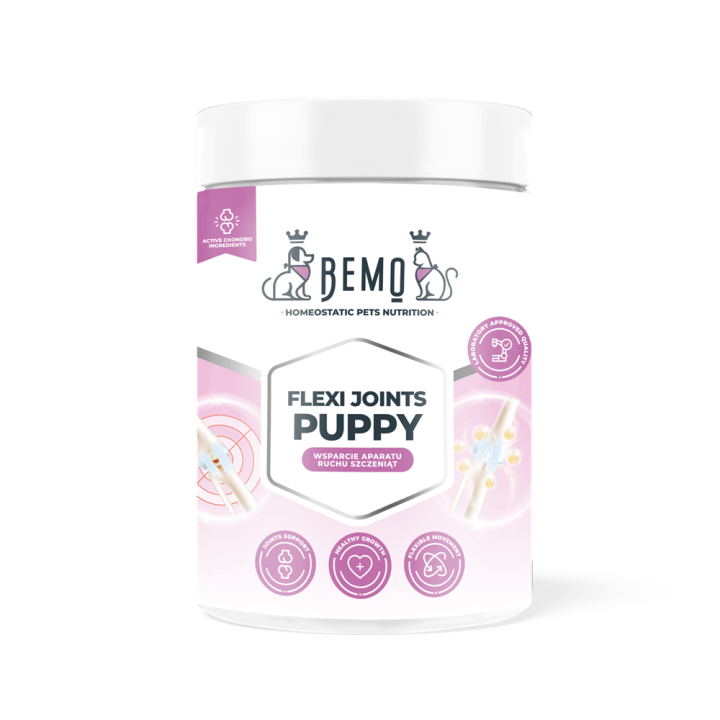

Bemo Flexi Joints Puppy - supplement for puppy joints
Time until reduction will end: 0 minutes
Product intended for chondroprotective dietary enrichment of puppies during periods of rapid growth. The composition of type II collagen and New Zealand green-lipped mussel (rich in GAG) strengthens the structure of the developing musculoskeletal system, helps stimulate cartilage tissue synthesis, and proper synovial fluid secretion in rapidly growing puppies. FlexiJoints Puppy contains substances that support the proper development of the digestive and immune systems of each puppy. The product is recommended for prophylactic use in puppies from 8 weeks to 9 months of age.
Bemo Flexi Joints Puppy - support for the musculoskeletal system of growing puppies.
Bemo Flexi Joints Junior is recommended for daily, chondroprotective dietary supplementation for puppies from 8 weeks to 9 months of age. The formula contains active ingredients such as type II collagen, hyaluronic acid, and New Zealand green-lipped mussel. The key active ingredients in the product excellently nourish the musculoskeletal system and improve mobility. Type II collagen excellently supports the structure and elasticity of joint cartilage. Glucosamine hydrochloride is responsible for stimulating cartilage regeneration and reducing the risk of damage. Chondroitin sulfate strengthens the cartilage. Hyaluronic acid exhibits synovial fluid properties, increasing its lubricating ability. The New Zealand green-lipped mussel (Perna canaliculus), also known as the green-lipped mussel, is often used as a supplement to support joint health in both humans and animals, including dogs. It contains glycosaminoglycans (GAG), omega-3 fatty acids, and other nutrients that support the construction of joint cartilage. In the Flexi Joints Puppy formula, we did not use popular chondroprotective substances: glucosamine and chondroitin, due to their less favorable impact on the developing skeletal system of the puppy. In young puppies, the skeletal system is in a phase of intense development and growth. Improper supplementation with substances that interfere with cartilage metabolism can potentially disrupt the natural maturation process of the joints. The natural maturation process of the skeletal system is precisely regulated, and an excess of these substances can lead to undesirable effects, such as imbalances between cartilage catabolism and anabolism. In summary: in young dogs without clear health problems, an excess of glucosamine and chondroitin is not only unnecessary but may disrupt the proper development of their joints. The supply of glucosamine and chondroitin should begin after the rapid growth phase of the skeletal system, which is after about 9 months of age (Flexi Joints Junior)
Flexi Joints Puppy - a formula supporting your puppy's joints!
Puppies, during intense growth, need excellent support for their developing musculoskeletal system. Bemo Flexi Joints Puppy is an excellent natural supplement supporting puppies of all breeds during the most important period of their lives. Hydrolyzed type II collagen is the main component of joint cartilage. In its hydrolyzed form (i.e., divided into smaller particles), it is easier for the body to absorb. It has a supportive effect on joint nutrition. Additionally, type II collagen contributes to the reconstruction of the cartilage matrix. Another active ingredient in the Flexi Joints Puppy formula is glycosaminoglycans (GAG) such as hyaluronic acid, which help moisturize and protect joint surfaces. Elastin and bioactive proteins support joint elasticity. Lysozyme, an enzyme with anti-inflammatory and antibacterial effects. GAG are organic compounds that are important for joint and connective tissue health because they have anti-inflammatory effects and support cartilage regeneration. Thus, FlexiJoints Puppy provides the necessary active substances to maintain the proper functioning of the musculoskeletal system. The product is recommended for daily preventive use in puppies. Particularly recommended for breeds prone to joint strain and breeds predisposed to musculoskeletal problems (large and giant breeds such as Newfoundland, Great Dane, Labrador Retriever, Tibetan Mastiff, etc.)
We especially recommend Bemo Flexi Joints Junior:
- as support for the musculoskeletal system of puppies
- for large and giant breed puppies
- during intense growth
- as support for the skeletal system of puppies of any breed
Do you know what the most common joint problems in dogs are?
Joint problems in dogs are quite common, especially in certain breeds and older animals. They can be related to age, injuries, genetics, or the dog's lifestyle. Below you will find an overview of the most common problems, their causes, and ways to address them:
Hip or elbow dysplasia
- A congenital defect in joint structure, leading to its deformation and degeneration.
- Most commonly occurs in larger breeds, such as Labradors, German Shepherds, or Rottweilers.
Osteoarthritis (arthrosis)
- Progressive damage to joint cartilage, leading to pain and stiffness.
- Often a result of aging, but also injuries or overloading.
Arthritis
- Can result from infection, autoimmune disease, or injury.
Dislocations and sprains
- Occur due to mechanical injuries.
- Often happen in active dogs or those that jump from great heights.
Ligament problems (e.g., anterior cruciate ligament rupture)
- An injury often seen in active dogs, leading to pain and limited movement.
Panosteitis ("bone inflammation in young dogs")
- A temporary problem in rapidly growing large breed dogs, causing joint pain.
Symptoms of joint problems
- Stiffness, especially after rest
- Lameness or avoiding weight-bearing on a limb
- Joint swelling
- Avoiding movement or activity
- Behavioral changes, such as irritability or apathy
- Difficulty getting up or jumping
Causes of joint problems
- Genetics: Many breeds are prone to joint disorders.
- Obesity: Excess weight puts additional strain on the joints.
- Age: Older dogs are more susceptible to degeneration.
- Physical activity: Too much strain or too little movement can contribute to problems.
- Diet: Deficiencies in nutrients such as glucosamine or chondroitin can weaken joints.
How to proceed?
Visit to the veterinarian
- Proper diagnosis (physical examination, X-ray, joint ultrasound).
- Treatment plan tailored to the dog's condition.
Pharmacological treatment
- Non-steroidal anti-inflammatory drugs relieve pain and reduce inflammation.
- Supplements supporting cartilage regeneration (glucosamine, chondroitin, hyaluronic acid).
Surgical procedures
- In cases of advanced conditions, such as ligament rupture.
Rehabilitation
- Muscle strengthening exercises, hydrotherapy, massages.
Lifestyle changes
- Controlling the dog's weight, avoiding excessive physical exertion.__ETS_NL
-
Brand
-
ReferenceFJPUPPY150
-
EAN135907196090141